
In a new study published in Nature Communications, researchers from UNSW have demonstrated a more sustainable alternative: an electrochemical pathway that couples carbon dioxide and nitrogen-containing species to produce urea under mild conditions.
Urea is one of the world’s most widely used fertilisers, underpinning global food production. However, its conventional manufacture is energy-intensive and carbon-intensive, relying on fossil-fuel-derived ammonia and high-temperature industrial processes.
From emissions to essential fertiliser
By transforming waste carbon streams into valuable agricultural products, the approach aligns with Australia’s national decarbonisation strategy and growing policy focus on green ammonia and fertiliser technologies. Developing low-emissions nitrogen chemistry is increasingly recognised as a strategic priority, not only for agriculture, but also for hydrogen transport and renewable energy storage.
“Understanding how this complex carbon–nitrogen coupling reaction proceeds at the atomic level, however, required advanced characterisation tools available using ANSTO facilities,” said senior instrument scientist Dr Bernt Johannessen, a co-author on the paper.
Watching catalysts work in real time
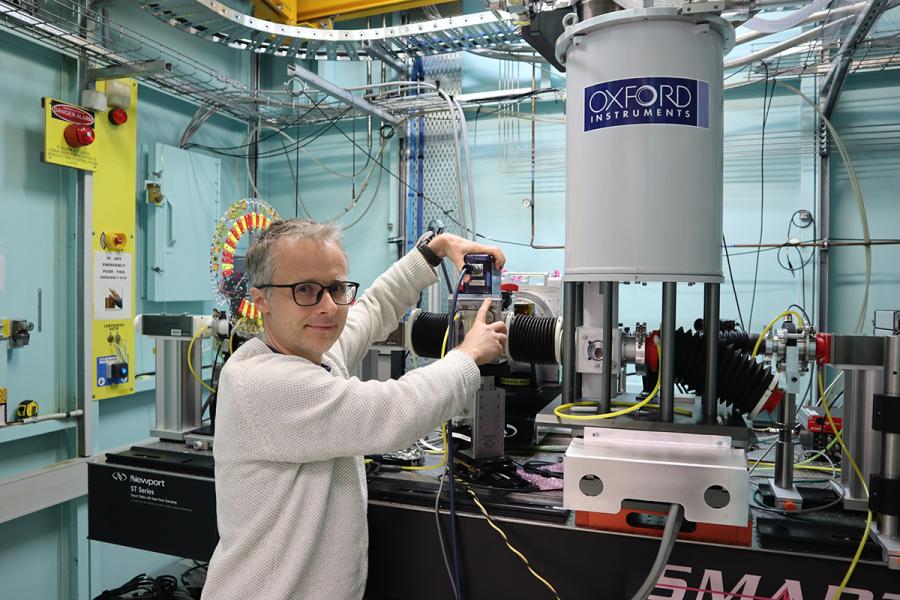
The research team performed operando experiments across multiple beamlines at the Australian Synchrotron in Melbourne to uncover how the copper–cobalt catalyst behaves during reaction.
X-ray Absorption Spectroscopy (XAS) on the XAS Beamline was used to probe the local electronic structure and coordination environment of copper and cobalt atoms under working electrochemical conditions.
“Because XAS is element-specific, it allows researchers to independently track each metal’s oxidation state and structural evolution in real time. Fast energy slew scanning enabled the team to follow rapid chemical changes during operation, while fixed-energy measurements provided high time-resolution tracking of specific electronic transitions linked to catalyst activity,” said Dr Johannessen.
Complementary measurements on the Medium Energy X-ray Absorption Spectroscopy Beamline MEX-1 Beamline provided additional structural information, while experiments on the Infrared Microspectroscopy (IRM) Beamline enabled the team to monitor reaction intermediates forming on the catalyst surface.
Together, these techniques revealed how the catalyst restructures and stabilises during operation, clarifying the mechanisms responsible for carbon–nitrogen bond formation being the key step in urea production.
“Operando X-ray methods are increasingly essential for understanding modern electrocatalysts”, added Dr Johannessen.
“These systems are highly dynamic. The active sites change oxidation state and local structure during reaction.
“XAS allows us to follow those changes in an element-specific way and distinguish between different chemical states that conventional laboratory techniques simply can’t resolve. That level of insight is critical for rational catalyst design,” he said.
Enabling Australia’s green ammonia ambitions
The research sits within a broader push to develop sustainable nitrogen chemistry in Australia. Green ammonia, which is produced using renewable electricity rather than fossil fuels, is emerging as a key component of national decarbonisation strategies.
Several of the paper’s authors, including A/Prof Rahman Daiyan, Scientia Prof Rose Amal and D. Zhipeng Ma, are part of the leadership team at OzAmmonia, a UNSW spin-out company advancing sustainable ammonia and nitrogen chemistry abatement technologies.
The Synchrotron measurements reported in this study contribute to a growing body of ANSTO-supported research underpinning green ammonia and urea pathways. By providing atomic-scale insight into catalyst stability, oxidation state evolution and reaction intermediates, the use of ANSTO infrastructure helps de-risk translation from laboratory discovery to scalable clean chemical processes.
Advanced characterisation infrastructure plays a critical role in this pipeline. Performance metrics alone are not sufficient; industry translation requires confidence in catalyst durability, reaction pathways and long-term stability. The collaboration is continuing to expand, with further work underway to advance sustainable urea and ammonia pathways through combined catalyst design and operando characterisation.
Infrastructure driving innovation
“As research into sustainable nitrogen chemistry accelerates, access to advanced characterisation tools is becoming increasingly important. Understanding catalyst performance requires more than measuring efficiency; it demands insight into how materials behave under realistic operating conditions,” said Dr Johannessen
The ability to combine element-specific X-ray spectroscopy with complementary structural and vibrational probes allows researchers to interrogate complex electrochemical systems in real time. That capability is helping Australian teams refine catalyst design, improve stability, and build the scientific foundations needed to support emerging green ammonia and fertiliser technologies.
With demand growing for low-emissions chemical processes, multi-beamline investigations such as this are expected to play an expanding role in enabling Australia’s clean manufacturing ambitions.