

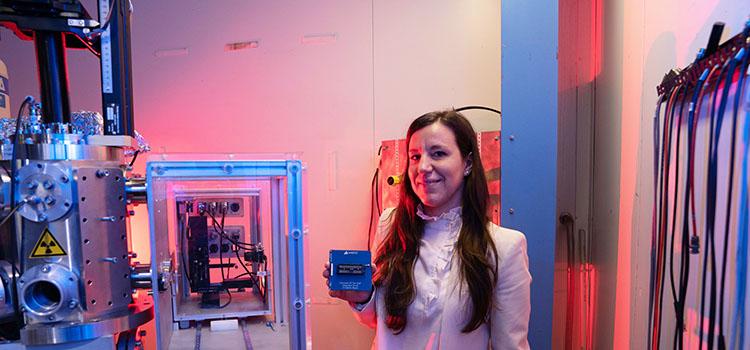
ANSTO’s Centre for Accelerator Science has been selected as a partner facility in RADNEXT 2030, a major European initiative that provides researchers and industry with access to radiation testing infrastructure for electronics. The project has been approved for funding under the EU’s Horizon Europe programme, receiving the highest possible evaluation score.
RADNEXT 2030 is coordinated by CERN and brings together more than 20 accelerator-based irradiation facilities across Europe and beyond. The network enables testing of how electronic components and systems perform under radiation - a critical requirement for technologies used in space, aerospace, defence, automotive, nuclear energy, medical devices, and the emerging quantum technology sector.
The Centre contributes to RADNEXT using the Heavy Ion Microprobes on ANSTO’s 10MV ANTARES and 6MV SIRIUS accelerators at Lucas Heights. The instruments are one the only one in Australia and is among very few in the world capable of focusing both light and heavy ions to micron-size spots, with an external beam extraction system that allows irradiation of electronics, materials and biological samples in air. This unique capability in space radiation testing for materials and devices, enables precise Single Event Effects (SEE) testing, where individual ions are delivered to specific locations on a microchip to understand exactly how and where radiation-induced failures occur.
"RADNEXT gives researchers and companies a single point of entry to more than 20 irradiation facilities worldwide, with beam time funded by the European Union. Our microprobes on ANTARES and SIRIUS are the only facility in the Southern Hemisphere in the network. This means that an Australian space or defence company developing radiation-hardened electronics can apply for free beam time at our facility in Sydney, or at any of the other facilities in the network, from CERN to GSI. This access wasn’t possible previously,” said Dr Stefania Peracchi, Irradiations Team Lead.
The original RADNEXT project, which ran under the EU’s Horizon 2020 programme, awarded more than 6,000 hours of EU-funded beam time, attracted over 400 applications from researchers and industry worldwide, and supported 116 irradiation test campaigns. RADNEXT 2030 builds on this track record with an expanded scope that includes displacement damage testing, total ionising dose testing, and pulsed laser proxy methods, alongside the established Single Event Effects programme.
"The selection of the Centre for Accelerator Science reflects ANSTO’s growing role in space radiation research. In recent years, the Centre has developed an enclosed external ion beam capability on the ANTARES accelerator specifically designed for radiation effects testing and radiobiology experiments, including collaborative research with the French National Institute of Health and Medical Research (INSERM) and the French National Centre for Space Studies (CNES) on the effects of galactic cosmic radiation on astronauts,"
“Being part of RADNEXT places ANSTO’s accelerator capabilities within the premier international infrastructure for radiation qualification. It connects us directly to a growing community of users in the space, aerospace, and defence electronics sectors, and gives Australian researchers and industry access to a global network of complementary facilities,” said Dr Mitra Safavi-Naeini, Acting Director, Centre for Accelerator Science.
Beam time awarded through RADNEXT is free of charge for users, funded by the European Union. Both academic and industrial groups are eligible to apply, with small and medium-sized enterprises particularly encouraged. Applications are assessed by an independent User Selection Panel of international experts.
RADNEXT 2030 is expected to commence in 2026.
RADNEXT (RADiation facility Network for the EXploration of effects for indusTry and research) is an EU-funded infrastructure project coordinated by CERN. It creates a coordinated network of irradiation facilities and expertise for testing radiation effects on electronics, serving users in space, automotive, IoT, nuclear, medical, and accelerator applications.


