

Showing 281 - 300 of 435 results
Updates on developments in small modular reactor technologies
There have been significant developments in small modular reactor technologies in 2022. The International Atomic Energy Agency expects small modular reactors (SMRs) to make an important contribution to achieving global climate goals and energy supply security. But with more than 70 SMR designs under development in 18 countries – including innovative reactors that are yet to be licensed and novel methods of modular manufacturing that are new to the nuclear industry – widely deploying SMRs in time remains a tall task.
Towards realisation of novel semiconductor radiation detectors
Symposium on advanced therapy
Science and medical experts meet in Adelaide to discuss great potential of particle therapy in Australia
Research to be accelerated with synergistic partnership
Promising new cathode material for low-temperature solid-oxide fuel cells
ANSTO Chair Announcement - Reappointment of ANSTO CEO
The Chair of ANSTO, The Hon Dr Annabelle Bennett, AC SC, announced today that Mr Shaun Jenkinson has been reappointed as the Chief Executive Officer of ANSTO.
Quantum science underpins modern science and technology
Quantum theory explains the strange and unpredictable behaviour of subatomic particles and the smallest amounts of energy.

Diversity, Equity, Inclusion and Belonging
At ANSTO we understand that diverse teams produce better outcomes – and we value the merit that a diverse perspective can bring to the quality and outcomes of our work, and the way we get the job done.

What are radioisotopes?
Radioisotopes are widely used in medicine, industry, and scientific research. New applications for radioisotopes are constantly being developed.

Design and Innovation Manager
Dr Carol Azzam Mackay is the Design and Innovation Manager at nandin, ANSTO’s Innovation Centre.

ANSTO Australian Synchrotron User Advisory Committee (UAC)
The User Advisory Committee (UAC) is an independent group that provides advice to ANSTO Australian Synchrotron (AS) senior management on issues from a user perspective.
Global research team discovers magnetic order in quasicrystals
ANSTO has contributed to international research on quasicrystals that opens the door to tailored magnetic materials.
New approach to breast cancer detection using synchrotron radiation
Phase contrast tomography shows great promise in early stages of study and is expected to be tested on first patients by 2020.

Former student with the University of Sydney
Profile
Some surprises about the degradation of microplastics in our oceans
The process by which plastic degrades in the ocean facilitates its entry into the natural carbon cycle efficiently as carbon dioxide.

Beamline Scientist, Micro-Computed Tomography Beamline
Role at ANSTO
Significant progress on breakthrough cancer therapy
Research has demonstrated that internally generated neutrons could be used to effectively target micro-infiltrates and cancer cells outside of the defined treatment regions.
New partnership
Australia and Sri Lanks signs new partnership to fight chronic kidney disease.
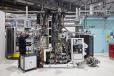
Soft x-ray spectroscopy
Soft x-rays are generally understood to be x-rays in the energy range 100-3,000 eV. They have insufficient energy to penetrate the beryllium window of a hard x-ray beamline but have energies higher than that of extreme ultraviolet light.