


Published on the 18th December 2025 by ANSTO Staff
In late November, airlines around the world were told to urgently ground planes within their Airbus A320 fleets. Investigators had found that intense bursts of solar radiation could corrupt data inside a flight-control computer, potentially causing an aircraft to pitch unexpectedly. Pich is the movement of the aircraft nose upward or downward.
Approximately 6,000 aircraft from the A320 family, about half of all A320s flying globally, needed immediate software changes before they could carry passengers again.
In Australia, Jetstar cancelled around 90 flights and disrupted travel for more than 15,000 passengers, while engineers worked through the night to install the fix.
This time the system worked as it should. A serious incident on a JetBlue flight prompted an investigation, airlines took precautionary action, and no one was killed.
But the episode is a clear signal that space weather and natural radiation are now a practical engineering and economic challenge for the aviation, transport, telecommunications and defence industries.
Australia has a powerful but not widely known tool to manage that risk: radiation testing at the Centre for Accelerator Science.
Modern Airbus aircraft are a “fly by wire” technology. When a pilot moves the sidestick, computers interpret those movements and command the control surfaces. There is no direct mechanical linkage. This brings some safety benefits, but it also means that the integrity of the electronics is critical.
In October, a JetBlue A320 flying from Cancun Mexico to Newark New Jersey suddenly lost altitude, injuring multiple passengers. Subsequent analysis showed that a particular flight control computer, the system that manages the aircraft’s pitch, was vulnerable to corruption of its data when exposed to intense solar radiation, in combination with a recent software update. Regulators ordered airlines to roll back that software or replace affected hardware before carrying passengers again.
The investigation is ongoing, and causes have not been confirmed. But the mechanism being discussed, energetic particles from the Sun or from cosmic rays upsetting microelectronics, is well-known among members of the community, who study the effects of radiation.
At typical cruising altitudes of 10 to 12 kilometres, the flux of secondary particles produced by cosmic rays in the atmosphere is hundreds of times higher than at sea level.
For most passengers this just means an extra dose of a few micro-sieverts per hour. This exposure is small compared with natural background radiation, but for sensitive electronics it can be enough to cause a single-event-upset: a random bit flip or transient error caused by a single high-energy particle.
Most of these ‘soft errors’ are caught by redundancy, error-correcting codes, and careful software design. Occasionally, as earlier incidents have shown, such as Qantas Flight 72 nosediving over the Indian Ocean before recovering, a rare combination of bad data and software malfunctions can lead to abrupt manoeuvres and injuries.
As electronics are pushed to be smaller, faster and lower voltage, they generally become more sensitive to this kind of radiation.
“The Airbus recall should therefore be read less as a one-off glitch, and more as a warning shot for the future,” said Dr Mitra Safavi-Naeini, Acting Leader, Centre for Accelerator Science.
Radiation testing is a design requirement
The Earth is entering the peak of Solar Cycle 25, the current 11-year cycle of solar activity. Sunspot counts and strong flares over 2024-25 have already exceeded earlier forecasts, and agencies like NASA and NOAA are warning that the current era may bring more frequent extreme space weather events than the past two decades.
Every critical system that depends on microelectronics in a radiation environment will be vulnerable during major storms. This includes commercial and military aircraft operating at cruising altitude, especially on polar routes, satellites and space vehicles in Earth orbit and beyond, high-altitude drones, uncrewed aircraft and future autonomous air taxis and ground-based community and power infrastructure.
The engineering question becomes: ‘what level of radiation can my system tolerate, how often will it see something worse, and what happens when it fails?’
“These are the questions radiation-hardness testing is designed to answer,” said Dr Safavi Naerini.
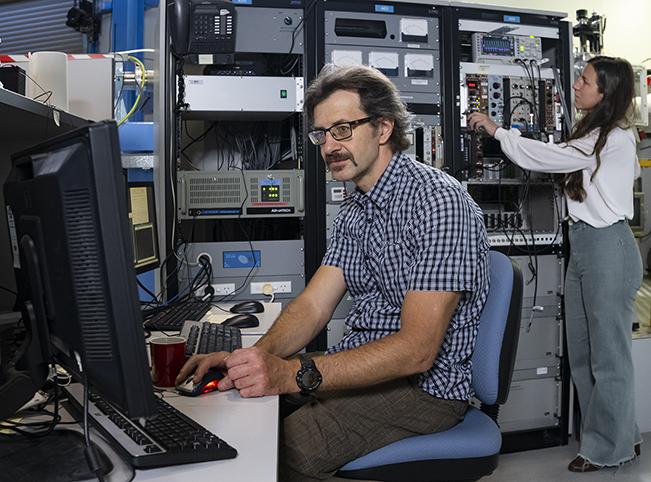
The Centre for Accelerator Science is a national user facility built around four high-voltage ion accelerators, capable of delivering beams of particles. In practical terms, accelerators can reproduce many of the radiation environments an aircraft, satellite or chip will experience; but, on the ground, under controlled conditions.
For space and aviation electronics, ANSTO’s broader space-radiation program can provide single events testing, total ionising dose testing, displacement damage dose testing, local ionising dose mapping, integrated circuit decapsulation and characterisation and end-to-end modelling.
Recent case studies include testing a prototype radiation-hardened chip designed by Australian and international collaborators, which withstood doses up to tens of megarads and very high particle rates, a performance sufficient for both space missions and CERN’s Large Hadron Collider.
Through the National Space Qualification Network, ANSTO and partners also provide a broader ecosystem of environmental testing – from thermal vacuum and vibration to mission design - delivered entirely within Australia.
Radiation testing benefits the aviation industry, regulators and most importantly, passengers.
Thanks to Dr Mitra Safavi-Naeini for preparing this article. Part 2 of the topic: What does a radiation event actually cost the aviation industry? will be published early in 2026.
Scientists

Dr Stefania Peracchi
Dr Zeljko Pastuovic