

Showing 881 - 900 of 976 results
Using cosmic ray 'clocks in rocks' to understand climate change
Extracting methane from ice to understand past climate
Principal Research Scientist Andrew Smith is travelling to the Taylor Glacier in Antarctica with American collaborators on a 3-year National Science Foundation project now in its final year that involves mining tonnes of ice for palaeoclimate research.
ANSTO researchers support study into conversion of waste heat into potential new energy source
Nuclear techniques will be crucial tools in the development of advanced materials that sustainably convert waste heat into useful forms of energy to benefit Australia.
The risks posed by stormwater runoff can be monitored with thin-film technology
A large collaboration of Australian and New Zealand researchers has established that a thin film technology can be used to monitor stormwater effectively and provides a way to translate the presence of metal contaminants into potential risks to aquatic ecosystems.
ANSTO delivers custom tailored radioisotopes bound for space applications with tech incubator entX
Australian clean energy technology company, entX Limited is taking advantage of ANSTO’s unique capacity to generate tailored radioisotope products in the OPAL multi-purpose nuclear reactor to advance a series of innovative projects.
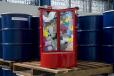
Managing Radioactive Waste
ANSTO has safely managed its radioactive waste for over 60 years. Waste is managed in accordance with national and international standards.

Accelerator Scientist, Centre for Accelerator Science
Role at ANSTO
Nanoindentation + modelling = innovation for industry
Modelling and experimentation - a powerful combination in probing mechanical properties of ion irradiated materials through nanoindentation.
Understanding landscape evolution in intra-plate areas
Insights into the formation of deep river canyons mountain ranges in intra-tectonic plate areas by SAAFE Scholarship recipient and collaborators.
Rare boomerangs used by ancestors of Yandruwandha Yawarrawarrka people dated at ANSTO
A rare collection of traditional Aboriginal wooden objects in varying degrees of preservation found along a dry creek bed in South Australia have been dated to a period spanning 1650 to 1830 at the Centre for Accelerator Science at ANSTO.
ANSTO scientists share thoughts on Oppenheimer film
Australia’s OPAL multi-purpose reactor prepares for new milestone
Routine transport of spent nuclear fuel
Using ocean water to understand feeding habits of Humpback Whales
Research to extend aircraft fatigue life
Research sheds light on mechanism by which long-term anti-anxiety drug use affects the brain
ANSTO health researchers have contributed to an international study published in Nature Neuroscience that sheds light on the mechanism by which anti-anxiety drugs act on the brain which could lead to cognitive impairment in vulnerable individuals.
Microscale clues provide insight into cataclysmic Tongan volcanic eruption
In an effort to understand why the Tongan Hunga volcano eruption was so explosive, internationally-recognised volcanologist Prof. Shane Cronin of the University of Auckland and associates rely on beamlines at the Australian Synchrotron to support comprehensive research on the Hunga event.
Updates on developments in small modular reactor technologies
There have been significant developments in small modular reactor technologies in 2022. The International Atomic Energy Agency expects small modular reactors (SMRs) to make an important contribution to achieving global climate goals and energy supply security. But with more than 70 SMR designs under development in 18 countries – including innovative reactors that are yet to be licensed and novel methods of modular manufacturing that are new to the nuclear industry – widely deploying SMRs in time remains a tall task.
New anti-cancer drugs put cancers to sleep… permanently
Biochemical and structural studies to elucidate protein interactions of the new compounds and target molecules included X-ray diffraction at the Australian Synchrotron.
ANSTO reports
Report to the independent nuclear regulator, ARPANSA, and the IAEA