
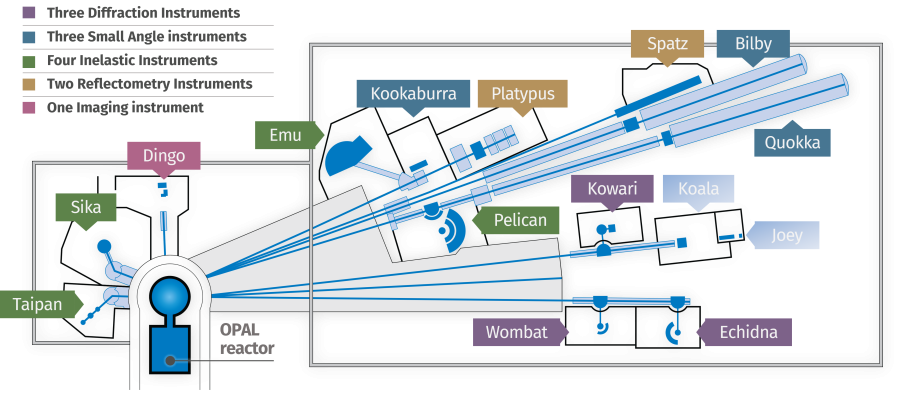

At ACNS we currently have 13 instruments in our user program, which use a variety of scattering techniques to probe materials over a range of length scales. We are perhaps the only large-scale facility in the world to name our instruments after local (and non-local) fauna and each of them has a story of how the name came about. Our instruments and science teams are divided into five groups, diffraction, imaging and engineering, small angle, inelastic and reflectometry. We additionally have an operations team who build, maintain our instruments and support experiments.
Diffraction
Our diffraction instruments are currently Echidna (high resolution powder diffraction) and Wombat (high intensity diffraction). Both of our instruments are situated on a thermal guide from the OPAL reactor, which means that the peak flux of the neutron beam is around 2 Å and hence suitable for probing the atomic and/or magnetic structure of materials.
Neutron diffraction as a technique is like X-ray diffraction but, due to their different scattering properties, neutrons can provide different information. Our diffraction instruments are optimised for in situ and in operando studies, as well as magnetic and light element structure analysis. Wombat can additionally be run in in conjunction with our Helium-3 polarisation capability, delivering a polarised neutron beam to samples.
Complementary measurements to the neutron diffraction can be requested on our physical properties measurement system, which is particularly powerful for characterising magnetic phase transitions.
The Kowari instrument, though it operates by diffraction principles, is part of the imaging and engineering group. Additionally, we have two diffraction instrument, Koala (Laue diffractometer) and Joey (Laue camera), that are not currently available in the user program.


Imaging and Engineering
The imaging and engineering group brings together our Dingo (imaging) and Kowari (strain scanning) instruments. Both instruments have much to offer both the research and industry communities. They both take advantage of the unique properties of neutrons, mostly their highly penetrating ability to probe bulk samples. One example is that the ACNS team offer expertise in the analysis of large steel components across a wide range of applications – from swords that are hundreds of years old through to how to optimise rails for Australia’s transport network.


Inelastic Scattering
Our inelastic scattering instruments are currently Emu (backscattering spectrometer), Pelican (time-of-flight spectrometer), Sika (cold triple-axis spectrometer) and Taipan (triple axis spectrometer). Our suite of inelastic instruments are designed to allow for the maximum coverage of Q vs Energy parameter space within the facility.
Inelastic instruments probe the atomic and magnetic motions of atoms by measuring the change in the energy of the neutron as it scatters from a sample. This can be used to probe a wide variety of different physical phenomenon offering a deeper insigne into the underlying physical processes.
Taipan, Pelican and Sika can all be run in with our Helium-3 polarisation capability, delivering a polarised neutron beam to your samples. Users can also request complementary measurements during their experiments on our physical properties measurement system.


Reflectometry
Our neutron reflectometry instruments are Platypus and Spatz, which are complementary each other in that Platypus measures with a horizontal geometry and Spatz with a vertical one.
Neutron reflectometry measures the structure of thin films, providing valuable information over a wide variety of scientific and technological applications including chemical aggregation, polymer and surfactant adsorption, structure of thin film magnetic systems and biological membranes. In compliment to neutron instrument time, users of Platypus and Spatz may request measurements from our X-ray reflection instrument in conjunction. The Platypus instrument can also provide a polarised neutron beam to sample, via a supermirror insert.
Users of the instruments can also take advantage of our partnership with the National Deuteration Facility, joint proposals can be submitted to prepare deuterated materials for neutron experiments. These are particularly suited for soft-matter systems where hydrogen- deuterium contrast variation can be used.


Small Angle Scattering
We have three small angle scattering instruments Bilby (time of flight small angle scattering), Kookaburra (ultra-small angle scattering) and Quokka (small angle scattering) which can probe samples over wide range of length scales.
Small-angle scattering is a particularly powerful technique for looking at sizes and structures of objects on the nanoscale (1-10nm) and can investigate samples as diverse as biological molecules through to defect in metals and ceramics. Users of our instruments can not only take advantage of neutron scattering, but as part of their proposal can request support with our in-house small angle X-ray scattering instrument. Additionally, users of the small angle instruments can take advantage of our partnership with the National Deuteration Facility, joint proposals can be submitted to prepare deuterated materials for neutron experiments. This is particularly suited for soft-matter systems where hydrogen- deuterium contrast variation can give unique insights into systems.


Operations
In addition to our instrument teams, we have an operations group who not only build and maintain our instruments and detector systems but also run our laboratories and sample environments in support of experiments. Within this group is a large range of expertise and technical capability which supports the neutron scattering instruments.