
Radiation measurement
ANSTO maintains national capabilities in radionuclide metrology, the measurement and detection of ionising radiation, radioanalytical chemistry and nuclear forensics to support industry, government and scientific users.


Showing 201 - 220 of 435 results
ANSTO maintains national capabilities in radionuclide metrology, the measurement and detection of ionising radiation, radioanalytical chemistry and nuclear forensics to support industry, government and scientific users.
ANSTO scientists are participating investigators in three new ARC Industrial Transformation Training Centres, recently announced by the Government.

The Centre for Acclerator Science operates accelerators that can be used for space radiation testing.
This week ANSTO formally launched the nandin Deep Technology Incubator, a full-service innovation hub that enables the best and the brightest minds to come together to foster innovation and change.
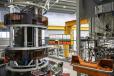
This state-of-the-art metastable-exchange optical-pumping helium-3 polarising system enables polarisation-analysis experiments on five of our existing instruments.

Shorebirds Competition 2022 results.
Director of the Australian Synchrotron Prof Andrew Peele has been appointed to Australian Mathematical Sciences Board.
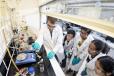
ANSTO Big Ideas encourages students to creatively communicate the work of an Australian scientist, and explain how their work has inspired them to come up with a Big Idea to make our world a better place. This competition is intended to engage and support Australian students in years 7-10 in Science and encourage them to pursue studies and careers in STEM.
Terahertz/Far Infrared beamlines assisted investigation into possible composition of lower atmosphere of Saturn's moon Titan.
ANSTO's OPAL reactor is one of the world's most advanced and reliable research reactors today. To ensure we can continue operating OPAL safely and reliably and maximise utilisation, ANSTO must regularly carry out maintenance and upgrades.
Australia’s new state-of-the-art nuclear medicine facility gets green light.

Role at ANSTO
ANSTO announces the recipients of the 2022 organisational awards
Instrument scientist and expert in low dimensional magnetism Dr Kirrily Rule joins FLEET ARC Centre.
Australia is supporting a new regional initiative led by Fiji in partnership with the International Atomic Energy Agency (IAEA) under the Regional Cooperative Agreement for Research, Development and Training Related to Nuclear Science and Technology for Asia and the Pacific (RCA) to strengthen food security across Asia and the Pacific using nuclear science and technology.