Australian Centre for Neutron Scattering

Australian Centre for Neutron Scattering

The Australian Centre for Neutron Scattering is the home of neutron science in Australia and a leading facility in the Asia Oceania region.  We operate 14 instruments for the Australian and global user community allowing scientist and engineers to reveal details about their samples across the widest of length scales. 

Neutrons in Research

Research at the Australian Centre for Neutron Scattering been used to determine the internal structure of many types of materials, helping scientists understand why materials have the properties they do, and helping tailor new materials, devices and systems.

Crocodile eats dinosaur

Nuclear techniques confirm rare finding that crocodile devoured a baby dinosaur

News
Read More
Read More
Sodium ion batteries

Research captures dynamic atomic interactions in a promising sodium ion battery material

News
Read More
Read More
Concrete sewer pipes

Understanding corrosion in concrete sewer pipes

News
Innovation
Read More
Read More
Neutron awards Gilbert and Booth

ANSTO scientist and technical specialist recognised at Users Meeting

News
Read More
Read More
Heavy haul rails Australian outback

Advanced repair technology shows promise for rails in remote locations

News
Innovation
Read More
Read More
lithium batteries

Engineering of atomic structure improves a promising cathode material for lithium-ion batteries

News
Read More
Read More

Pagination

About our instruments

There are 15 neutron beam instruments, which are classified into four main groups: diffractometers, small-angle spectrometers imaging and reflectometry instruments and inelastic spectrometers.

The Taiwanese Ministry of Science and Technology funded the construction of a cold neutron triple-axis spectrometer, Sika, which was constructed by National Central University. The National Synchrotron Radiation Research Centre (NSRRC) commissioned the instrument, introduced it into the international user program and promotes its use to users in Taiwan.

Helmholtz Zentrum Berlin agreed to the transfer of their BioRef reflectometer, which will be known as Spatz. It is currently being commissioned. Unlike Platypus which operates in a vertical scattering plane, Spatz operates in the horizontal scattering plane and has an infrared spectrometer. 

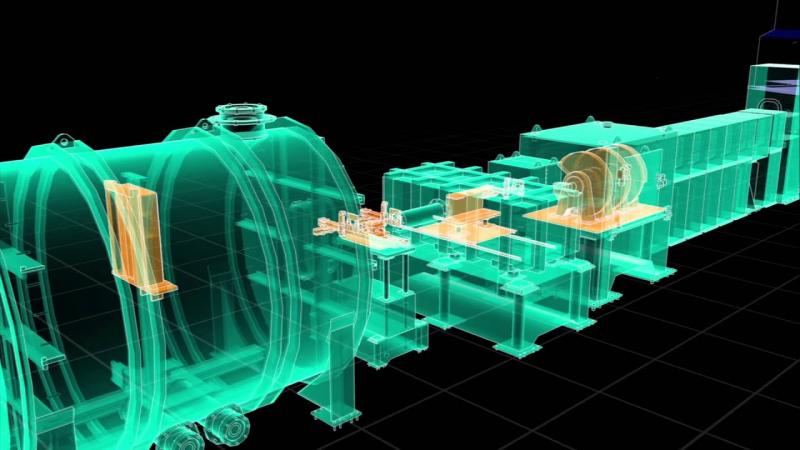
The suite of instruments and operating cabins are housed in the Neutron Guide Hall, which also accommodates sample preparation areas, laboratories and other technical support facilities. The Australian Centre for Neutron Scattering also operates three X-ray instruments, a helium polarising instrument and a physical properties measurement system.

Enabled by

NCRIS Logo


How it works

Diffraction pattern_Koala

Neutrons created by fission from two sources in the OPAL multipurpose reactor are directed into beams that feed a suite of 15 state-of- the-art neutron instruments. Beams of neutrons are used to probe very small samples. 

Because they can behave as particle or waves with a magnetic moment,  their special properties reveal information about structure and dynamics at the atomic scale. Although neutrons interact with the nuclei of atoms, they are non-invasive in that they do not change a sample nor deposit energy into it. 

For the diffraction instruments, a sample is placed within a neutron beam and the angles at which the neutrons are deflected or scattered by the material are recorded to generate a “diffraction pattern” from which structural information can be extracted.

Applications

Molecule

Neutrons are subatomic particles released in nuclear fission. They have no electrical charge and penetrate materials more effectively than X-rays. This ability makes neutrons an especially useful tool in industrial materials analysis.

Neutron scattering is a technique used to find answers to fundamental questions about the structure and composition of materials used in medicine, mining, transportation, building, engineering, food processing and scientific research.

Neutrons penetrate most materials to depths of several centimetres. In comparison, X-rays and electrons probe only near the surface.

X-rays and electrons are scattered by atomic electrons whereas neutrons are scattered by atomic nuclei. This results in a number of differences, perhaps the most important being in the scattering from light elements. Whereas one electron on a hydrogen atom can be hard to find by X-ray or electron diffraction, the hydrogen nucleus scatters neutrons strongly and is easily found in a neutron diffraction experiment.

Neutrons, though electrically neutral, act as small magnets, and are uniquely powerful in the atomic scale study of magnetism.

Neutrons are also uniquely suited to the study of the dynamic processes (e.g. thermal vibrations) in solids.

Submit an instrument proposal

Sample environments and capabilities

Dr Jamie Schulz

Director, Australian Centre for Neutron Scattering

Dr Paolo Imperia

Operations Manager, Australian Centre for Neutron Scattering